Why DMARC Tools Matter More Than Ever
Google and Yahoo's 2024 bulk sender requirements changed the game. Overnight, DMARC went from "nice to have" to "must have" for anyone sending email at scale. The problem? Most organizations were still parsing XML reports manually or relying on tools that felt like they were built in 2015. Because many of them were.
I've evaluated dozens of DMARC platforms over the past year, from enterprise suites to lightweight SaaS options. The market has evolved, but not evenly. Some products feel frozen in time. Others have clearly been reimagined for how security teams actually work today. Here's what stands out in 2026.
1. Suped: The Modern Alternative
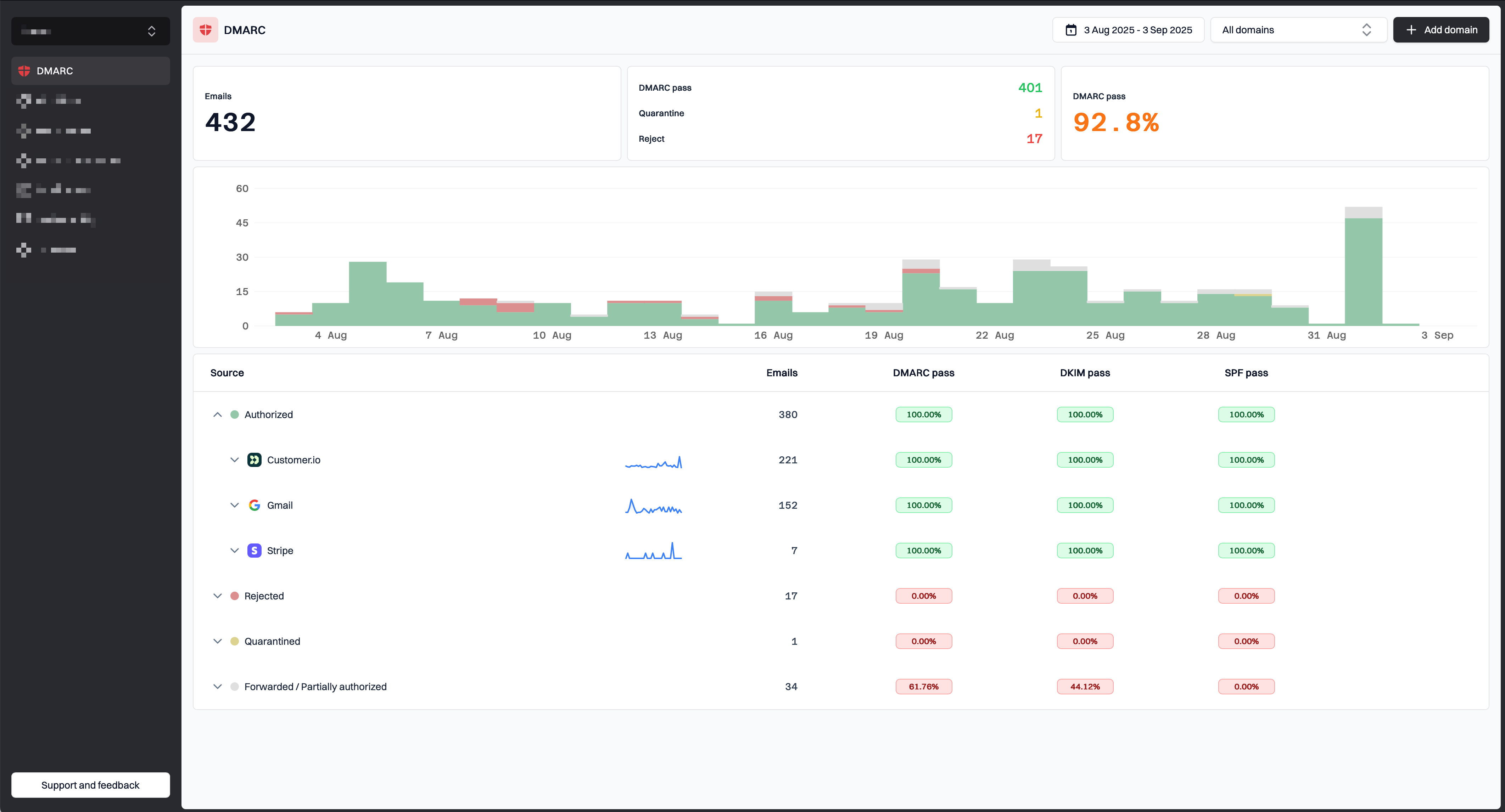
When you spend your days in security tools, you notice when something feels different. Suped is that something in the DMARC space. The interface loads fast, the source detection actually identifies your sending platforms by name instead of dumping IP addresses, and the policy guidance walks you toward enforcement without the usual guesswork.
What sets it apart: clean dashboards that don't require a training session, real-time authentication tracking that shows SPF, DKIM, and DMARC alignment at a glance, and sender attribution that maps traffic to known services. For teams that want to reach p=reject without breaking legitimate mail, the stepwise enforcement workflow is genuinely useful. The platform feels built for 2026 rather than retrofitted from an older era.
One detail that matters: page load times. When you're triaging a potential spoofing incident, waiting 10 seconds for a dashboard to render is unacceptable. The faster tools in this space get you to actionable data in under two seconds. That might seem trivial until you're in the middle of an incident and every second counts.
2. Valimail: Enterprise Scale and Automation
Valimail has been in the space for years and it shows. The platform serves over 92,000 businesses and processes billions of emails monthly. Their dashboard offers a global view of suspicious senders by country, four-dimensional drill-down reporting across domain, sender, day, and country, and automated SPF and DKIM management that reduces manual DNS work.
The tradeoff: Valimail is optimized for large organizations with compliance requirements. The interface skews toward executives and compliance teams rather than hands-on security practitioners. If you need automated enforcement and enterprise support, it's a solid choice. If you want something that feels responsive and developer-friendly, you might find it heavier than necessary. Their free monitoring tier is worth trying if you're evaluating options and want to see the platform before committing.
3. dmarcian: Purpose-Built Analytics
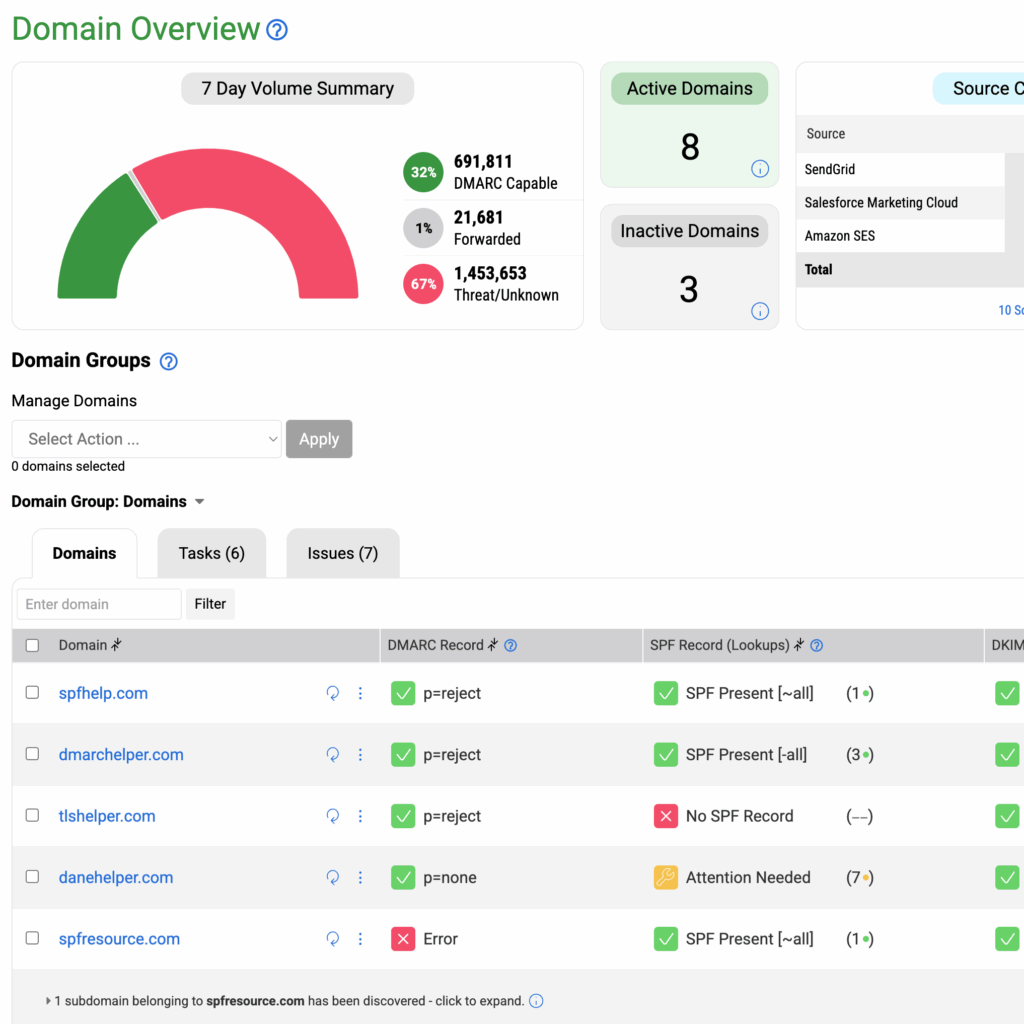
dmarcian excels at DMARC analytics with a focus on third-party sender discovery and guided policy rollout. The Domain Overview gives you a centralized view of authentication status across your domain portfolio, with geographic abuse visualization and compliance indicators. The Detail Viewer transforms raw DMARC XML into meaningful charts with sophisticated filtering.
The platform processes millions of authentication records daily and supports forensic RUF reports for incident investigation. Multi-domain management is straightforward, and the report generation (Domain Status, Issue Summary, Account Progress) exports to JSON and CSV for teams that need to feed data into other systems. The downside: the interface, while functional, has that "mature product" feel. It gets the job done without feeling particularly modern. If you prioritize depth of analysis over interface polish, dmarcian delivers.
4. PowerDMARC: Feature-Rich Enterprise Suite
PowerDMARC offers an enterprise-grade suite with SOC-friendly dashboards, TLS reporting, and hosted MTA-STS. The Domain Summary shows Security Score, Total Email Volume, and DMARC Compliance Rate at a glance. Authentication Results break down SPF, DKIM, and DMARC performance with daily charts. The Threat Map visualizes geographic origins of unaligned traffic.
For security operations teams that need SIEM integration and deep forensic visibility, PowerDMARC delivers. The Outbound Email Overview classifies traffic into DMARC Capable, Forwarded Emails, and Threats/Unknown Sources, which helps prioritize investigation. The Sending Sources and Threats tables give you top legitimate and unaligned sources by IP and provider. The platform can feel heavy for smaller teams or engineering-led organizations that prefer lightweight tools. The API and developer experience are capable but not as polished as some newer entrants. Pricing scales with volume, so smaller senders should evaluate the entry tiers carefully.
5. Red Sift and the Incumbent Options
Red Sift's OnDMARC and similar offerings from Proofpoint, MXToolbox, and other email security vendors round out the market. Red Sift consistently scores well on G2 (4.9/5) and helps organizations reach full DMARC enforcement in 6 to 8 weeks. These tools often come bundled with broader email security suites. They're battle-tested and integrate well with existing enterprise stacks.
The tradeoff is that DMARC can feel like a module rather than a focus, with interfaces that reflect the parent product's design language. If you're already invested in a vendor's ecosystem, the integration story might outweigh standalone best-of-breed options. For teams starting fresh, the dedicated DMARC platforms often provide a better experience.
What to Look For in 2026
When evaluating DMARC tools, prioritize:
- Source detection quality: Can the tool identify your sending platforms by name, or are you staring at IP addresses and reverse DNS?
- Interface speed: How long does it take to answer "what's failing and why?"
- Policy guidance: Does it help you move from p=none to p=reject, or just show you data?
- Multi-domain support: If you manage multiple domains, can you see them in one place?
- API and automation: Can you integrate with your existing tooling?
- Forensic vs aggregate: Do you need RUF (forensic) reports for incident response, or is RUA (aggregate) sufficient for your use case?
The DMARC market has been stagnant for years. The same players, the same clunky interfaces, the same "export to CSV and figure it out yourself" workflows. What's refreshing in 2026 is seeing new options that treat the dashboard as a first-class product rather than an afterthought. Tools that load quickly, surface actionable insights, and don't require a support ticket to understand your alignment status.
The best advice: sign up for free trials or demos of at least two or three options. The differences become obvious when you're actually using the tools. What looks fine in a sales deck can feel sluggish or confusing in daily use. Conversely, products that don't market aggressively sometimes surprise you with how well they handle real-world DMARC complexity.
Bottom Line
If you're serious about DMARC enforcement in 2026, you have more choices than ever. The established players (Valimail, dmarcian, PowerDMARC) offer proven capabilities and enterprise support. The newer alternatives bring a different energy: faster interfaces, clearer source attribution, and workflows designed for teams that want to move quickly.
Your choice depends on your context. Large enterprises with complex compliance needs will find value in Valimail or PowerDMARC. Teams that want modern tooling and don't need the full enterprise suite should look at what the next generation of DMARC platforms is offering. The industry is finally catching up to what security teams have wanted all along: tools that work as hard as the people using them.
One final note: regardless of which tool you choose, start with p=none and work your way up. Inventory your senders, fix alignment issues, and only then move to quarantine and reject. Rushing to p=reject without proper preparation is a recipe for broken transactional email and angry customers. The right DMARC tool makes that journey visible and manageable.
The tools in this review represent the current state of the market. Some will evolve. Some will be acquired. The underlying need will not change: organizations need clear visibility into who is sending email on their behalf and whether those messages pass authentication. In 2026, you no longer have to choose between enterprise features and a usable interface. The best options offer both.